
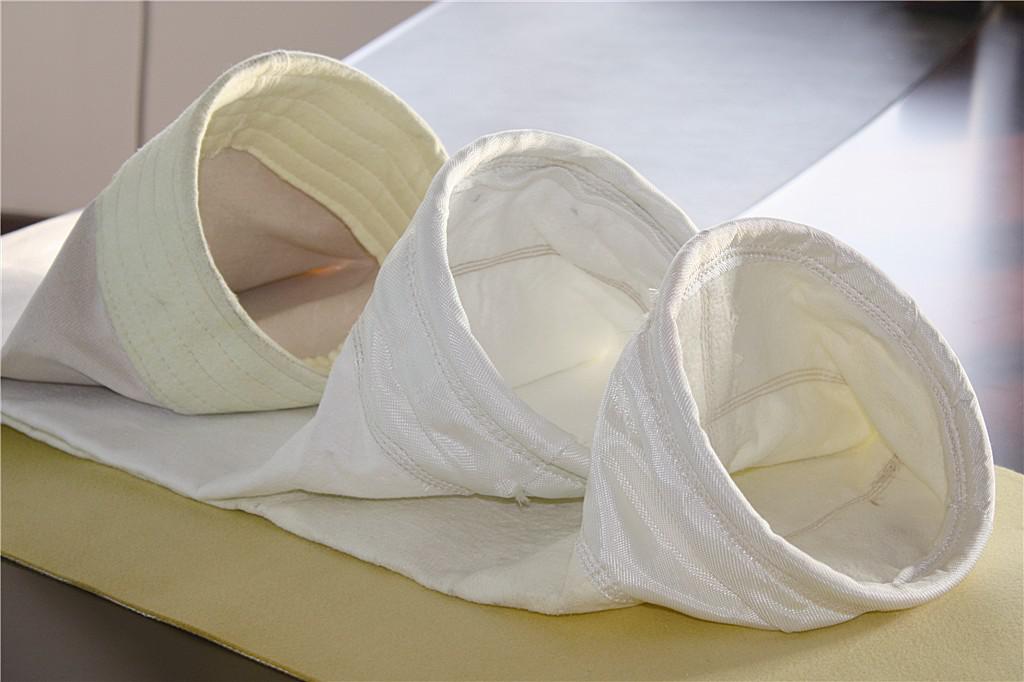
Fiberglass needle punched felt is a structurally sound and high-performance high-temperature resistant filter material. It not only has the advantages of high temperature resistance, corrosion resistance, dimensional stability, minimal elongation and contraction rate, and high strength of fiberglass fabric, but also the felt layer fiber supports single fibers, three-dimensional microporous structure, high porosity, and low gas filtration resistance, making it a high-speed and efficient high-temperature filtration material. Compared with other high-temperature resistant synthetic fiber felts, it has special advantages such as low price and higher temperature resistance. But its operating resistance is higher than that of general chemical fiber high-temperature filter materials, and the filtration accuracy is slightly lower.
Application: Fiberglass needle punched felt can be widely used for high-temperature flue gas filtration in various industrial furnaces such as chemical, steel, metallurgy, carbon black, power generation, cement, etc. Suitable for various bag filters such as pulse cleaning and high-speed reverse blowing cleaning.
| Model | Regular wool surface | Single sided film coating | |
| Weight in grams | 800 | 900 | |
| Air permeability (L/㎡/S) | 200~300 | 200~300 | |
| Fracture strength (N/5 × 20cm) | > 1850 | > 1800 | |
| Latitude | > 1600 | > 1800 | |
| Elongation at break (%) | < 10 | < 10 | |
| Latitude | < 10 | < 10 | |
| Tensile strength at break (Mpa/min) | 3.1 | 3.0 | |
| Operating temperature (℃) | 260~300 | 260~300 | |
| Acid resistance | Excellent | Excellent | |
| Alkali resistance | Good | Good | |
| Wear resistance | Poor | Poor | |
| Hydrolytic stability | Good | Good | |
| Post processing method | PTFE impregnation and shaping | Coating and shaping | |
Continuous fiberglass filter cloth
Glass fiber is an inorganic fiber whose main component is SiO2. It is made by melting glass material at a temperature of 1300-1600 ℃, drawing fibers from the molten state, and rapidly quenching. The specific gravity is 2.54g/cm3, and the tensile strength of the raw silk is between 160-275kg/m2. Two types of filtering materials are generally used: C glass (i.e. medium alkali glass or calcium sodium calcium silicate glass) and E glass (i.e. alkali free glass or aluminum borosilicate glass).
At present, the glass fibers used in the production of filter fabrics in China mainly adopt alkali free 80, medium alkali 45, and alkali free 40, with single fiber diameters of 6 μ, 7.5 μ, and 8 μ, respectively
The most tangible advantages of glass fiber are high temperature resistance, good dimensional stability, and high tensile fracture strength. Glass fiber is stable to all media except hydrofluoric acid and high-temperature strong alkali in terms of chemical resistance.
The disadvantage of glass fiber is poor flexural resistance, which requires post-treatment such as PTFE impregnation to improve its performance. The glass fiber is not resistant to bending, and the fabric filter material is cleaned with low-pressure back blowing, while the needle punched felt is cleaned with pulse cleaning. Glass fiber expanded filter cloth with a weight of over 700 grams can be cleaned by rotary back blowing or low-pressure pulse blowing.
Fiberglass bag recommended filtration wind speed:
| Types of filter media | Applicable filtering wind speed (m/min) |
| Continuous glass fiber filter cloth | 0.3—-0.6 |
| Glass fiber expanded yarn filter cloth | 0.4—-0.8 |
| Glass fiber needle punched felt filter material | 0.7—-1.0 |
Continuous fiberglass filter cloth
Glass fiber expanded yarn filter cloth
Glass fiber expanded yarn filter cloth is a new type of fabric developed on the basis of continuous glass fiber flat width filter cloth. Unlike continuous glass fiber filter cloth, the weft yarn is composed of all or part of expanded yarn. Due to the fluffy yarn, strong coverage ability, and good breathability, it can improve filtration efficiency, reduce filtration resistance, and has a high dust removal efficiency of over 99.5%, with a filtration speed of 0.6-0.8 meters per second.